There’s no shortage of advice on how to earn money as a blogger.
Quick hacks, monetization “tricks,” and viral strategies flood the internet every day.
The problem? Most of it skips the fundamentals.
Without a solid foundation, blogging is like rowing a boat upstream with broken paddles. You can kinda get the job done with enough effort but it’s damn exhausting.
That’s why I developed the BACM framework, a system for aligning the four key components of any content-based business.
When these components are in sync, your blog can grow efficiently, attract the right audience, and generate meaningful revenue without losing traction.
In this post, I’m breaking everything down so you can position your blog so it sticks.
Important note: This article is aimed at established bloggers that want to breathe new life into an existing blog. New bloggers will find value here but just be aware that the subject matter is less beginner friendly than a lot of other articles we publish. At a minimum, you should have a VERY clear understanding of your blog’s niche. If you need help narrowing down your niche, read this post first.
What is the BACM Framework?
BACM stands for:
- Business Model
- Audience
- Content
- Marketing
Think of it as a series of interlocking gears:

Business Model ⮂ Audience ⮂ Content ⮂ Marketing
Each part feeds into the next.
If one is misaligned, your whole system loses efficiency and it suddenly turns into the blogging equivalent of trying to drive a car with square wheels.
Now, it may seem self explanatory but the devil, as they say, is in the details.
It’s not enough to look at the top-level overview of this framework and immediately know how to use it.
There’s a lot of nuance.
So, I’ll walk you through how everything connects together and provide you with examples so you can do the same for your own blog.
0. Get crystal clear on your niche
Before we go any further, we need to quickly talk about your niche.
This entire framework relies on you having a crystal clear understanding of your niche.
And we need to address some pre-conceptions because what some people think of as a niche isn’t a niche. It’s an industry and that’s just too broad.
I’ve written a complete guide to choosing a niche. I’d recommend reading it first.
But, I’ll address the important points here so you can crack on quicker.
Here is the essence of finding your niche:
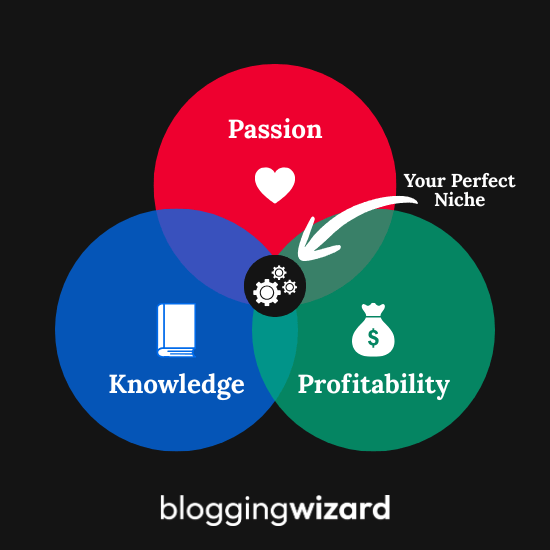
From there, you might come up with things like travel, cooking, pets, gaming, finance, technology, etc.
These aren’t niches. They’re industries and they’re far too broad.
So, you need to get specific. Some quick examples:
- Gaming → Retro gaming
- Gaming → VR gaming
- Travel → Travel in Switzerland
- Pets → Ducks
- Cooking → Meals for diabetics
- Finance → Bitcoin
See the difference? These niches are extremely specific.
The more specific your niche, the easier it will be to build an audience and compete with larger platforms on a more level playing field.
But there is a point where you can get too specific and end up with the tiniest possible audience. So, yeah, don’t do that.
Note: Back in the day, I ran a gaming blog with some friends. We were quite successful but we eventually fizzled out because we went too broad and ended up competing with sites like IGN. Niche blogs are where it’s at.
1. Business Model: Define how you’ll make money
Your business model is the backbone of your blog. Get this right and a lot of things get easier later on.
Now, it’s important to note that you can (and should) have multiple revenue streams but you need to choose one as your core revenue generation channel.
Start by answering these questions:
- Which monetization method will form my core business model?
- Do I want quick income or long-term passive revenue?
- Which monetization methods will I add later on?
Here are some examples of revenue models with additional insights:
- Freelancing/consulting: Quick income, direct client relationships. Combine with affiliate marketing as a secondary income source and scale faster by leveraging white label services.
- Affiliate marketing: Slower to ramp up but can generate passive income over time but you need lifetime commission products with high commission rates to minimize risk.
- Digital products: You need the knowhow to create products, an ecommerce platform to help you sell them, and an audience. Pairs well with affiliate marketing as a secondary revenue channel.
- Display ads: You can get started right away with platforms like Google AdSense but requires a lot of traffic to drive meaningful revenue.
- Merchandise: I wouldn’t recommend this as a core business model for new blogs. It’s better as a complimentary revenue channel. You’ll need a decent sized audience to make this work. However, you can get started without investing much money if you opt for a print-on-demand approach. For example, you can launch a store and sell products without paying for inventory using Sellfy.
Note: Choose a model that aligns with your long-term goals. Don’t let small ad revenue distract you from a high-value opportunity, like securing a $40K freelance client.
2. Audience: Know who you’re trying to reach
Your audience provides the demand for your content.
Their challenges will play a large part in how you approach your content strategy and the products you sell.
Without a clear picture of who they are, your content and monetization strategy can fall flat.
You’ll need to answer these questions:
- Who am I trying to reach?
- What problems do they need solved?
- Where do they spend their time online?
- What is the best way to put my content in front of them?
You need to boil this down to a type of person. For example, chefs, startup founders, bloggers, etc.
Then you’ll need to put together an audience persona. This is just a collection of all the info you have on your ideal reader. Sites they visit, their hopes, fears, challenges, etc.
You’ll be able to use this information to create a meaningful content plan that resonates with them, develop products they’ll actually want to buy, etc.
3. Content: Identify content types that fit your business model
It’s not enough to just build a content plan around your ideal reader and call it a day.
Content should serve your audience and your business model.
A big part of this boils down to the types of content you publish.
For example, how-to guides, tutorials, and opinion pieces can be a great way of attracting freelancing clients.
But reviews? Not so much. They are great for affiliate marketing though.
Reviews are also terrible when pairing with display ads. Ads require content that can drive significant volumes of traffic. They can sort of work for huge sites publishing reviews on products like the latest iPhone. But niche blogs can’t compete there. That’s why trend-jacking and news related content work well there.
So, you’ll need to map your content types to your business model.
Note: You’ll need to develop a content strategy but that’s another topic entirely. The idea here is that you’ll identify the best content types to focus on when you create your content strategy. Also, you should always try to publish a mix of content types and add more content types as you expand into new revenue streams. The same goes for formats; blog posts, long-form video, short-form video, infographics, etc.
4. Marketing: Get your content in front of your target audience
Content without marketing is, well, just content. Specifically content that just gathers dust in some dingy corner of the web.
And we don’t want that, right?
Your content deserves eyeballs. So, let’s make that happen.
Now, it’s time to figure out which marketing channels will work best with your chosen business model, audience, and content.
Let’s go through a few top-level examples:
If you’re focused on affiliate income, SEO is a good fit there. SEO provides high-intent traffic that’s well suited to things like reviews, Best X posts, etc.
You can get extra mileage from your content by repurposing it into long-form and short-form videos. YouTube videos are especially useful because they give you an extra opportunity to rank in organic search.
And YouTube’s own search engine is one of the most popular search engines in the world. Second only to Google itself.
If you’re focused on display ads, social media and SEO can work well. You’d need to split your content strategy between posts that will perform well on social and posts that will perform well in organic search.
Freelancers and consultants may find LinkedIn specifically to be quite useful.
What about selling digital products?
Social media and SEO can work well for your content. And you can send direct traffic to your sales pages or lead gen pages using platforms like Facebook Ads. Just be sure to cap your ad spend and set budgets. Meta will always try to get you to spend more than you want, if you let them.
And regardless of whether you use paid traffic or not, you’ll need strong email marketing automation in place to make sure you’re selling while you sleep.
That said, most blogs would benefit from building some kind of email list. Even if it’s just an email newsletter and you don’t use it to sell products, it provides a way to get eyeballs on your content without being a victim to shifting algorithms.
Note: It’s outside of the scope of this post, but I’d definitely recommend repurposing your content into other formats where possible. For example, one blog post can be turned into a long-form YouTube video, multiple short-form videos, and various written or image-based snippets.
Examples: How to make the BACM Framework work
I’ve covered some brief examples above but we need to get more specific.
So, to help you see how this framework can be applied to your own blog, I’ve included some specific scenarios below.
First, we’ll cover how not to do things. Then I’ll cover some scenarios that are on point.
Examples of BACM Misalignment ❌
1. Misaligned content
Scenario: A wearable tech blog wants to make money via affiliate marketing for software tools but mostly publishes opinion pieces about tech culture.
Why misaligned: The content doesn’t match the business model. Affiliate revenue relies on product-focused content, so the posts are unlikely to convert readers into buyers. Marketing may drive traffic, but the content itself fails to monetize effectively.
2. Misaligned marketing
Scenario: A luxury travel blog monetizes via ad revenue but spends most of its time promoting posts through LinkedIn, where travel content gets minimal engagement.
Why misaligned: The marketing channel doesn’t match the audience’s behavior. Even though content is solid and monetization is appropriate, the wrong promotional strategy limits traffic and revenue.
3. Misaligned business model & audience
Scenario: A vegan food blog targets beginner home cooks but relies on premium online cooking courses for revenue.
Why misaligned: The business model is too advanced for the audience. Beginners may not be willing to pay for high-priced courses, leaving the monetization strategy ineffective despite quality content and marketing efforts.
4. Multiple misalignments
Scenario: A fitness blog wants to monetize via affiliate supplements but targets casual readers and focuses on lifestyle articles. They post mainly on TikTok but don’t optimize their website for SEO.
Why misaligned: Business model, audience targeting, content, and marketing are all out of sync. The blog is unlikely to generate meaningful revenue because no component reinforces the others.
Examples of BACM Alignment ✅
1. Aligned for affiliate marketing
Scenario: A gardening blog targets beginner plant owners, creates detailed product reviews and how-to guides, and promotes content via Pinterest and SEO-optimized blog posts.
Why aligned: Business model, audience, content, and marketing all support each other. Affiliate links in relevant content reach the audience effectively through the right marketing channels.
2. Aligned for freelancing services
Scenario: A web design blog targets small business owners, publishes case studies and tutorials, and uses LinkedIn outreach and email newsletters to generate client leads.
Why aligned: Every component flows toward the same goal; acquiring freelance clients. Content educates the audience, marketing channels reach decision-makers, and the business model suits the audience’s needs.
3. Aligned for display ads
Scenario: A celebrity news blog targets general entertainment readers, posts frequent trending news articles, and promotes via social media and search traffic.
Why aligned: High-traffic content fits a display ad business model, and marketing channels drive sufficient pageviews. The audience enjoys frequent content, creating scalable ad revenue.
4. Aligned with mixed monetization
Scenario: A fitness blog targets active adults, publishes how-to guides, product reviews, and workout videos, and promotes via YouTube, Instagram, and SEO. Monetization includes affiliate links, ad revenue, and an online course.
Why aligned: All components work together. Content suits the audience, marketing channels match consumption habits, and multiple monetization streams reinforce each other, creating a cohesive, profitable strategy.
Final thoughts
If you’ve felt like you’re stuck on some kind of merry-go-round of blogging mediocrity, understanding and applying the BACM framework will help you stop the ride.
You can then reposition your blog for impact and profit. Taking an approach that makes your business model, audience, content, and marketing work together.
I’m not going to tell you that this framework is easy to apply. It’ll take some research and critical thinking.
It is, however, seriously worthwhile.
Just don’t forget about what I said about choosing a niche earlier. It’s pretty much the bedrock this framework is built upon. Get that right and it makes everything a lot easier.
It’s a shame I didn’t figure this all out before shuttering my gaming blog. But, it is what it is. 🫠
Now, there’s just one more thing I need to mention before signing off:
If anyone tells you the absolute best thing for your business without understanding the needs of your business, ignore them.
If you read an article that says you should do X, Y, and Z to grow your business, you should always view it in the context of your own business needs.
Don’t let random pieces of advice without context steer your business.
Work to understand your business model, your audience and the best content & marketing mechanisms to drive growth for your specific business model.
Disclosure: Our content is reader-supported. If you click on certain links we may make a commission.
Leave a Reply